Published: 9 October 2026 | Updated: 9 October 2026
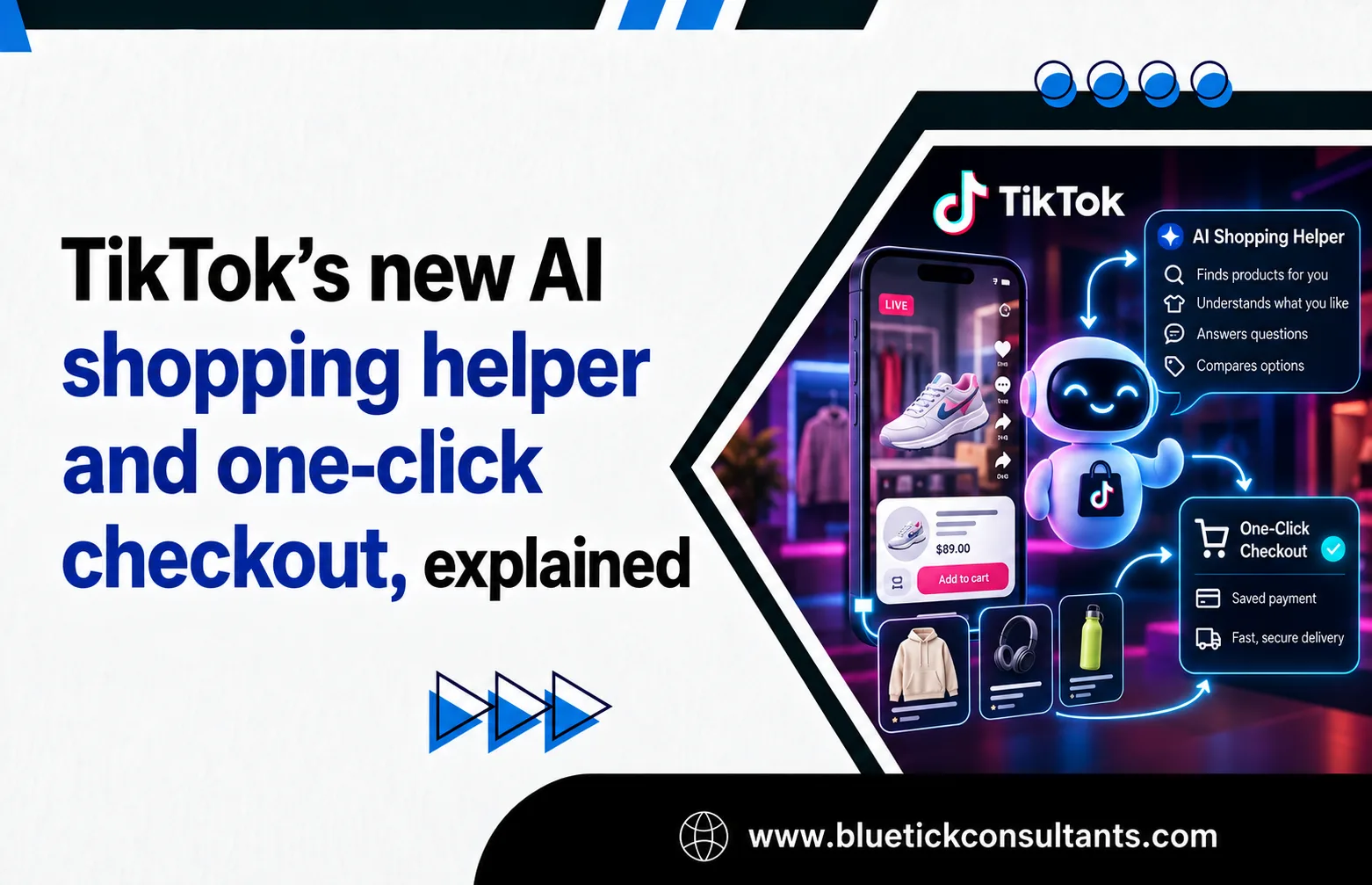
Short answer: The TikTok AI shopping assistant is a chat window on a brand’s product page that answers questions about sizing, delivery and stock. Buy Direct is a one-click checkout in the For You feed. TikTok announced both on 5 October 2026.
Bottom line: Both are in limited testing with selected brands, and TikTok has not published a fee. Shops should get the fee in writing before building anything.
The problem
You are watching a video. Someone is wearing a pair of hiking boots you like, so you tap the ad. Then the chore begins. A new website loads slowly. You hunt for the size chart. However, you cannot tell whether they deliver to you or how long it takes. Then the site asks you to create an account and type in your address and card number on a small screen.
As a result, most people give up somewhere in that list. You do not get the boots, and the shop loses a sale it had almost made. TikTok says the same thing in its own words: interest that starts with a video can fade once shoppers have to leave to hunt for details, and too many steps at the till make people abandon the purchase altogether.
What we’re solving
On Monday 5 October 2026, at Advertising Week in New York, TikTok announced two features aimed at those two drop-off points: unanswered questions and a slow till.
- Shopping Assistant is a chat window that sits on a brand’s product page inside TikTok. You ask it things like “do these run small?” or “when would they arrive?” and it answers in plain sentences. TikTok calls it a conversational AI agent, which simply means software you can talk to that keeps track of what you have already said.
- Buy Direct is a one-click purchase from the For You feed, the main stream of videos TikTok picks for you. It uses the payment card and address you have already saved, and you can track the order inside the app.
- The brand stays the seller. TikTok says brands remain the “merchant of record”, meaning the business that is legally responsible for the sale, the refund and the tax. That is the main difference from TikTok Shop, where TikTok runs the marketplace.
- Partners named: Salesforce, Shopify, Shoplazza and Stripe, which supply the shop and payment systems behind it.
What it does not solve
- It is not available to everyone. Many headlines say TikTok “rolls out” these tools. TikTok’s own business blog says they are offered through “eligibility-based testing”, and brands must ask their TikTok sales contact whether they qualify. No list of countries or dates has been published.
- The assistant is not an independent adviser. It builds its answers from information the brand supplies. Treat it like a well-informed shop assistant, not like a neutral reviewer.
- The two features are separate. In the assistant flow TikTok describes, you still pay on the brand’s own website, opened inside TikTok. The one-click part is Buy Direct only.
- It does not help you decide whether you need the thing. It removes steps. However, it does not add second thoughts.
A real example
Honest caveat first: TikTok has published no results from its tests, and no brand has yet reported numbers. So the best real evidence is what TikTok already sells, and what happened to the closest earlier attempt.
- TikTok’s own illustration: you see an ad for hiking boots and wonder whether the material will hold up on granite trails, whether they fit true to size, and what colours exist. The assistant answers on the spot, and you carry on to pay.
- TikTok already sells a lot. TikTok Shop opened in the US in September 2023. Research firm eMarketer estimates it made about $15.8 billion in US sales in 2025, roughly 18% of all US shopping done through social apps.
- People do buy after watching. A report TikTok published the week before says 54 million Americans have bought a product after seeing it in a TikTok video.
- The cautionary tale is ChatGPT. OpenAI launched Instant Checkout inside ChatGPT in September 2025, with Shopify, Etsy and Stripe on board. By March 2026 it was scaling the feature back. Reports put the number of Shopify shops that ever went live at somewhere between a dozen and about 30. People were happy to research products in the chat. However, they did not finish paying there.
How does Buy Direct compare with ChatGPT Instant Checkout?
Side by side, from published reports as of 6 October 2026:
| ChatGPT Instant Checkout | TikTok Buy Direct | |
|---|---|---|
| Where you buy | Inside a chat conversation | Inside the video feed |
| Launched | September 2025 | Announced 5 October 2026 |
| Status today | Scaled back in March 2026 | Limited testing with eligible brands |
| Fee to the shop | 4% of the sale, as reported in January 2026 | Not published |
| Who is the seller | The shop | The shop |
| Results so far | Weak uptake by shops and buyers | None published |
- Why TikTok might do better: people open ChatGPT to ask questions, but they already buy on TikTok. Why it might not: nobody outside TikTok has seen the numbers yet.
How it works (with code)
Buy Direct needs the brand’s shop to speak a shared language with TikTok. That language is the Universal Commerce Protocol, or UCP. It is an open standard that Google introduced in January 2026. Think of it as a universal plug socket: any app that follows the standard can plug into any shop that follows it, without a custom adapter for each pair.
- Step 1: the app tells the shop which item you want. The shop opens an order and replies “incomplete”, because it does not yet know where to send it.
- Step 2: the app sends your saved address. The shop works out delivery and tax and replies with a final total.
- Step 3: the app sends a payment token, a one-time stand-in for your card so the shop never sees the real number. The shop charges it and replies “completed” with an order number.
- Why it feels like one click: TikTok already holds your address and card, so it can send all three messages back to back.
What does the checkout look like in code?
The short Python program below acts out the shop’s side of those three steps. It is a simulation based on Google’s published UCP checkout guide, not TikTok’s own code, which is not public. It leaves out sign-in, card handling and network calls.
# A pretend brand's checkout, following the UCP steps a one-click buy goes through.
PRICES = {"trail_boot": 12900}   # cents, from the brand's own product list
TAX_RATE = 0.08                  # made-up rate, for the demo only

def create(item_id, qty):                 # POST /checkout-sessions
    line = {"item": {"id": item_id}, "quantity": qty}
    return {"id": "sess_1", "status": "incomplete", "line_items": [line],
            "subtotal": PRICES[item_id] * qty}

def update(s, postal_code, shipping=600):  # PUT /checkout-sessions/{id}
    tax = round(s["subtotal"] * TAX_RATE)
    s.update(ship_to=postal_code, shipping=shipping, tax=tax,
             total=s["subtotal"] + shipping + tax, status="ready_for_complete")
    return s

def complete(s, payment_token):           # POST /checkout-sessions/{id}/complete
    if s["status"] != "ready_for_complete":
        raise ValueError("address and payment must be set first")
    s.update(status="completed", order_id="ORD-1001")
    return s

# One click: the app already holds the saved address and card, so it sends all three.
s = create("trail_boot", 1)
print("1.", s["status"], "| subtotal $%.2f" % (s["subtotal"] / 100))
s = update(s, "94043")
print("2.", s["status"], "| total $%.2f" % (s["total"] / 100))
s = complete(s, "tok_saved_card")
print("3.", s["status"], "| order", s["order_id"])
Output when run:
1. incomplete | subtotal $129.00
2. ready_for_complete | total $145.32
3. completed | order ORD-1001
- The three functions match the three messages above: open the order, add the address, take the payment.
- The code holds prices in cents (12900 means $129.00), as the real standard does, to avoid rounding slips.
- The total of $145.32 is $129.00 for the boots, $6.00 delivery and $10.32 tax. The 8% tax rate and the $6.00 delivery are made up for the demo.
- The shop refuses to finish the order unless the address and payment step has happened first. That check is the shop’s protection against a half-filled order.
- Notice who does the sums: the shop, not TikTok. That is what “the brand stays the seller” means in practice.
What it costs
For shoppers, both features are free to use. However, the cost is indirect: the easier it is to pay, the easier it is to overspend.
For shops, the honest answer is that TikTok has not published a fee for Buy Direct or Shopping Assistant. The table below shows what is known for each realistic route, including doing nothing. All figures are in US dollars, for US sellers, checked on 6 October 2026.
| Option | Platform fee | Card processing | Hidden costs | Best for |
|---|---|---|---|---|
| Do nothing: send shoppers to your own site | $0 | 2.9% + $0.30 per sale (Stripe standard rate) | Shoppers who give up on the way | Shops with a fast site and loyal buyers |
| Sell through TikTok Shop | 6% on most categories in TikTok’s public fee table. Seller guides report 8% since 4 August 2026 | Included in the fee | Creator commissions you set, refund charges, less control | Shops that want TikTok to run the store |
| Buy Direct | Not published | Your own processor’s rate, since you remain the seller | Building the UCP connection, ad spend, getting accepted into testing | Brands already on Shopify, Salesforce or similar, selling impulse-priced items |
| Shopping Assistant | Not published | Your own, since payment happens on your site | Keeping product details accurate and current, ad spend | Products that attract lots of questions |
| For reference: ChatGPT Instant Checkout (scaled back March 2026) | 4%, as reported | About 2.9% + $0.30 on top | Very few buyers finished paying | Reference only |
What that means on a $50 order
- Your own site: about $1.75 in card fees.
- TikTok Shop: $3.00 at 6%, or $4.00 if the reported 8% rate applies to you. In addition, add whatever commission you offer creators.
- ChatGPT Instant Checkout, when it ran: about $3.75.
- Buy Direct: unknown. Expect at least the $1.75 in card fees, because you are still the seller. Whether TikTok adds its own cut on top is the question to ask your sales contact.
Costs that are not on the invoice
- Setup time. If your shop runs on one of the named partner platforms, the platform may handle much of the connection for you. If it is custom-built, a developer has to build it.
- Data upkeep. The assistant repeats what you tell it. A stale delivery time or a wrong size chart becomes a wrong promise to a customer.
- Disputes. You remain the seller, so chargebacks land on you. Stripe’s standard charge is $15.00 per dispute received.
- Dependence. Sales that happen inside TikTok depend on TikTok’s rules and fees, which it can change.
Which option suits whom
- Solo seller: stay as you are or use TikTok Shop. You are unlikely to be in the test group yet.
- Small team: ask your TikTok contact about eligibility, but do not build anything until the fee is in writing.
- Large brand: worth a test, with a clear measure of extra sales against extra cost.
Pros and cons
Pros
- Fewer steps for shoppers. No new website, no re-typing a card number.
- Questions get answered at the moment you have them, about the thing you are looking at.
- Brands keep the sale and the legal relationship, unlike a marketplace listing.
- It is built on an open standard backed by large shops and payment firms, so the work a brand does for TikTok may be reusable elsewhere.
- TikTok starts from real buying habits, which ChatGPT did not have.
Cons
- It makes impulse buying easier. An April 2026 opinion piece in the Michigan Journal of Economics argued that TikTok’s mix of persuasive videos and instant purchase already pushes people to buy without comparing or thinking it over. One-click checkout removes one more pause.
- The adviser works for the seller. The assistant’s answers come from the brand’s own information, and TikTok has not said what model powers it or how it handles a question the brand would prefer not to answer.
- The price is unknown. No fee has been published, and it is not clear who carries the risk when a payment is disputed.
- The last big attempt flopped. ChatGPT’s in-chat checkout was scaled back within about six months.
- Most brands cannot use it yet. It is a limited test, with no public timetable.
- It suits cheap, quick purchases best. Someone buying a $2,000 item compares, reads reviews and often phones first. Therefore, one click is not what holds them back.
- Open questions for brands. TikTok has not said how much customer information, such as an email address, the brand receives after a Buy Direct sale.
Key takeaways
- TikTok announced two things on 5 October 2026: a chat helper that answers product questions, and a one-click checkout in the video feed.
- Both are in limited testing with selected brands. In other words, this is not yet something every user or every shop will see.
- The brand stays the legal seller, which sets this apart from TikTok Shop.
- The brand feeds the assistant. It is a salesperson, not a reviewer.
- TikTok has not published what it charges. Shops should get that in writing before building anything.
- A similar idea inside ChatGPT was scaled back after about six months. TikTok’s advantage is that people already shop there, but there are no results yet to prove it.
Frequently asked questions
What is the TikTok AI shopping assistant?
Shopping Assistant is a chat window on a brand’s product page inside TikTok. It answers questions about sizing, delivery and stock using information the brand supplies.
What is TikTok Buy Direct?
Buy Direct is a one-click purchase from the For You feed. It uses the payment card and address you have already saved, and you can track the order inside the app.
Is TikTok Buy Direct the same as TikTok Shop?
No. In TikTok Shop, TikTok runs the marketplace. With Buy Direct, the brand stays the merchant of record, so it remains legally responsible for the sale, the refund and the tax.
Who can use the TikTok AI shopping assistant and Buy Direct?
Both are offered through eligibility-based testing. Brands must ask their TikTok sales contact whether they qualify. No list of countries or dates has been published.
How much does TikTok Buy Direct cost shops?
TikTok has not published a fee. Because the brand stays the seller, shops should expect at least their own card processing cost, which is 2.9% + $0.30 per sale on Stripe’s standard rate.
What is the Universal Commerce Protocol?
The Universal Commerce Protocol, or UCP, is an open standard that Google introduced in January 2026. It lets any app that follows it complete a checkout with any shop that follows it. Buy Direct needs it.