Published: 8 October 2026 | Updated: 8 October 2026
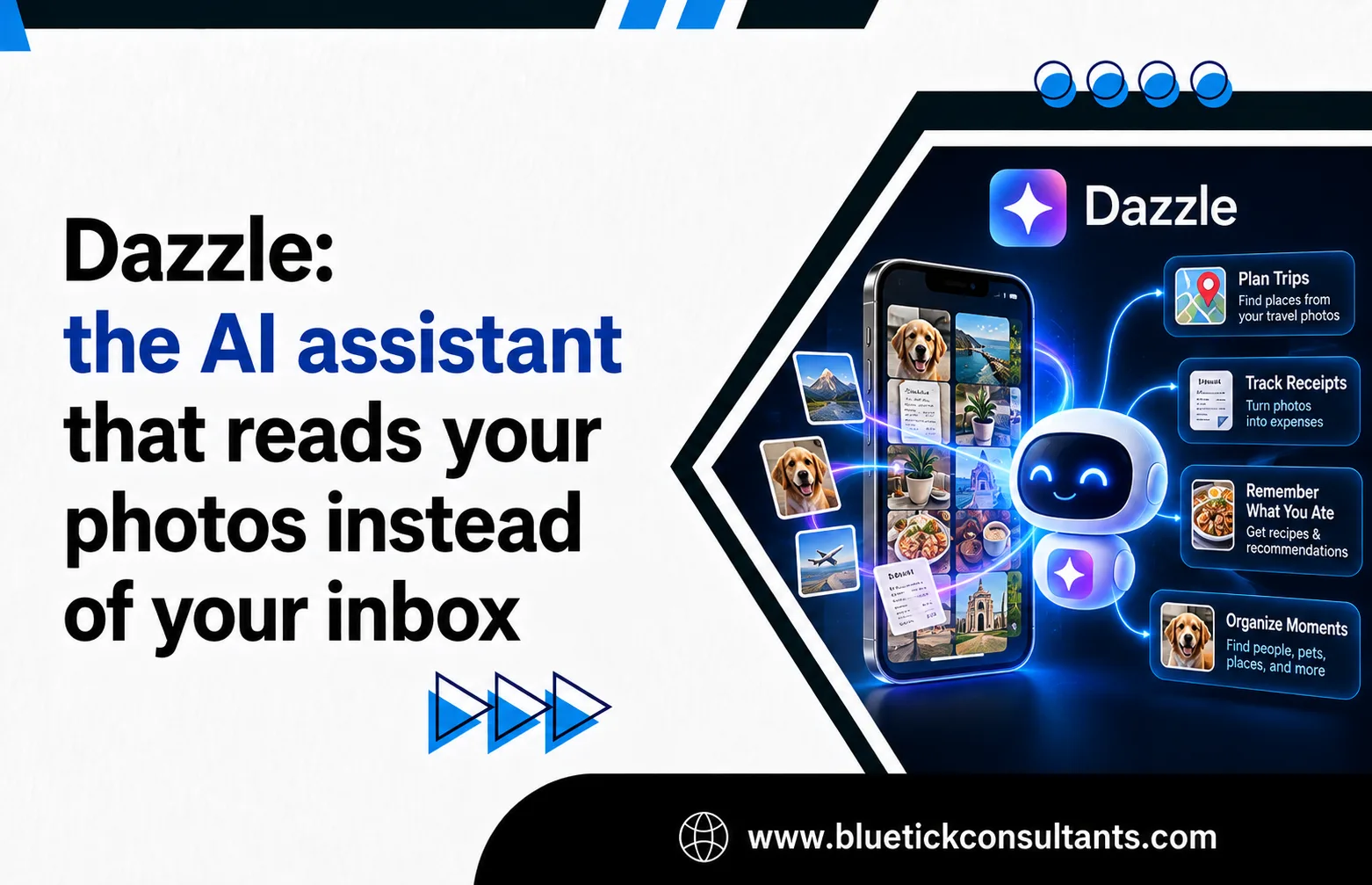
Short answer: The Dazzle AI assistant is a personal AI assistant from Marissa Mayer’s startup, Dazzle AI, launched on 29 September 2026. It learns about you from your camera roll instead of your email. It turns recent photos into tasks and older photos into ideas.
Bottom line: The Dazzle AI assistant is free for now, invite-only and iPhone only. The real cost is your photos, which are stored on Dazzle’s servers. Start with selected photos, not full access.
The problem
You open an AI chat app and it greets you with an empty box. It knows nothing about you. So before it can help, you have to explain yourself: who your family is, what you like, what your budget is, what you did last time. Every single time.
Some newer assistants try to fix this by reading your email and calendar. That helps with work. It does not help much with real life, because your inbox does not know your daughter loves skating or that your garage door is broken.
Meanwhile, the answers are already sitting on your phone. You photographed the broken door. You took a screenshot of the jacket you wanted. You have six years of holiday pictures. None of it is doing anything.
What we’re solving
Dazzle is a personal AI assistant launched on 29 September 2026 by Dazzle AI, the startup founded by former Yahoo chief executive Marissa Mayer. Its pitch is three words: pictures, not prompts.
- What it removes: the blank box. Dazzle builds its picture of you from your camera roll, so you do not have to type out your life story first.
- Get It Done: it looks at recent photos and screenshots and asks why you took them. A flyer becomes a calendar entry. A flat tyre becomes a repair booking. A jacket becomes a place to buy it.
- Ideas: it uses your older photos to suggest restaurants, concerts, trips and gifts that fit your taste.
- Chat: a normal AI chat, but one that already knows your context. Dazzle says it runs on “frontier models”, meaning the most capable AI models from the big labs. It does not say which ones.
- Where it lives: an iPhone app, iMessage and text, and the web at dazzle.ai.
What it does not solve:
- It is not open to everyone. As of 5 October 2026 the site says “currently invite-only”.
- There is no Android app listed. The only app link is the Apple App Store.
- It does not read your email, messages or bank. That is deliberate, but it also means it misses whatever you never photographed.
- It does not act alone on money. Dazzle says purchases and bookings need your explicit approval.
- It is not fully automatic yet. The company says human support staff step in on complicated tasks “for now”.
A real example
Dazzle is one week old, so there are no long-term customer stories yet. The best evidence so far is a hands-on test by TechCrunch reporter Marina Temkin, published on launch day, plus what Mayer says about her own use.
- Mayer’s own use: she says Dazzle worked out from her photos that her family loves escape rooms. It then suggested several San Francisco Bay Area venues she had never heard of.
- What worked for the reporter: asked for holiday ideas, Dazzle suggested Mediterranean spots, likely because of her past trips to Spain and Greece. It also suggested a local pottery studio and a night kayak tour, which she liked.
- What did not: it recommended Sicily, where she had already been four years earlier. And when she asked whether to buy her daughter roller skates, it did not know the girl could already skate.
- Her verdict: the ideas felt more personal than what an email-and-calendar assistant gives. But she was undecided on whether she would keep using it, and wrote that Dazzle “isn’t as broadly useful as other offerings quite yet”.
That is one reviewer and one founder. Treat it as an early signal, not proof.
How it works (with code)
Dazzle has not published its internal code. What it has published is the outline: photos are uploaded to its servers, sensitive ones are thrown away, the rest are analysed to build a profile, and recent ones are checked for tasks. The short Python example below is our own simplified sketch of that idea, not Dazzle’s code. It uses plain text labels in place of real image analysis so anyone can run it.
from collections import Counter

# Each photo is described by labels an image model might produce.
photos = [
    {"id": 1, "labels": ["ski", "mountain", "family"]},
    {"id": 2, "labels": ["passport", "document"]},
    {"id": 3, "labels": ["escape room", "family"]},
    {"id": 4, "labels": ["flat tire", "car"]},
    {"id": 5, "labels": ["ski", "snow"]},
    {"id": 6, "labels": ["event flyer", "date"]},
]
SENSITIVE = {"passport", "document", "bank statement", "prescription"}
ACTIONS = {
    "flat tire": "Find a tyre repair shop",
    "event flyer": "Add the event to your calendar",
}

# Step 1: drop anything that looks sensitive before learning from it.
kept = [p for p in photos if not SENSITIVE & set(p["labels"])]

# Step 2: count what shows up most. That becomes the profile.
profile = Counter(label for p in kept for label in p["labels"])

# Step 3: treat each remaining photo as a possible to-do.
todos = [ACTIONS[l] for p in kept for l in p["labels"] if l in ACTIONS]

print("Photos kept:", len(kept), "of", len(photos))
print("Top interests:", [label for label, n in profile.most_common(2)])
print("Get It Done:", todos)
Output when we ran it:
Photos kept: 5 of 6
Top interests: ['ski', 'family']
Get It Done: ['Find a tyre repair shop', 'Add the event to your calendar']
What that code is doing, in plain words:
- Each photo is reduced to a few labels, such as “ski” or “flat tire”. In the real product an AI model that can read images does this part.
- Step 1 throws out the passport photo before anything is learned from it. This mirrors Dazzle’s stated rule: “When in doubt, we leave it out.”
- Step 2 counts what appears most often. Two ski photos and two family photos become “this person likes skiing and family time”.
- Step 3 treats each remaining photo as a possible job. The flat tyre and the flyer each turn into a suggested action.
- The real system is far more complex. Dazzle lists seven patent applications, covering things like building a map of places and a map of relationships from photos.
If you already use another AI agent
- Dazzle offers a connector so other agents can use what it has learned from your photos. It names Claude, Codex, OpenClaw and Hermes.
- The connector uses MCP (Model Context Protocol), a common standard that lets AI tools plug into outside data sources.
- For OpenClaw the published install command is one line. We could not run it here, because it needs the OpenClaw tool and a Dazzle account:
clawhub install dazzle-photo-intelligenceWhat it costs
Prices are in US dollars and were checked on 5 October 2026. Dazzle has no pricing page. The “free for now” figure comes from Mayer’s launch-day interview with CNBC, where she said transaction fees or a subscription may come later. Meta Muse prices were confirmed by Meta to CNBC. Instinct publishes no prices.
| Option | Upfront cost | Ongoing cost | Hidden costs | Best for |
|---|---|---|---|---|
| Do nothing: keep typing prompts | $0 | $0 on free chat apps | Your time. You re-explain yourself in every chat | Anyone not ready to share personal data |
| Dazzle | $0 | Free for now. Fees or a subscription may come later | Your photos are stored on Dazzle’s servers. Invite wait. iPhone only | iPhone users who want ideas and errands from photos |
| Meta Muse | $0, but a payment card is asked for at sign-up | Free tier, then $20 or $100 a month by usage | Connects to email, calendar and payments. US only at launch | People who want an agent across email and bills |
| Instinct | $0 | Free during invite-only beta. No published price | Very broad account access. Documented security incidents in beta | Early adopters comfortable with risk |
How to read this table:
- Free is not the same as free forever. Dazzle raised $8 million in seed funding at a $35 million valuation. Storing and analysing whole photo libraries costs real money, so a price is likely.
- The real payment today is data. Dazzle’s own developer page says it “processes and stores your photos on our servers”.
- Solo user: try Dazzle with a hand-picked set of photos, not the full library. It costs nothing and limits what you share.
- Family: remember your photos contain other people. They did not agree to be analysed.
- Business or team: nothing here is built for work. Dazzle is aimed at personal life.
- Readers outside the US: the text line is a US-style short number (742213) and Meta Muse is US only. We could not confirm whether Dazzle invites are being issued in India or elsewhere.
Pros and cons
Pros
- No cold start. It has context from the first minute, without a long setup chat.
- Covers home life. Photos capture hobbies, kids, trips and repairs, which email mostly misses.
- Narrower access than rivals. It does not ask for your passwords, inbox or messages. Dazzle says its agent uses its own accounts and acts “on your behalf, not as you”.
- You choose the scope. Full library, selected photos, or no photo access at all.
- Clear promises on data use. Dazzle says personal data is not used to train public AI models, not used for third-party advertising, and not sold.
- Easy exit. Deleting your account deletes the synced photos from its servers, according to the company.
Cons
- Your photos leave your phone. They are stored on company servers, which makes the company a target for hackers.
- A camera roll is not harmless. Privacy site All About Cookies points out that screenshots often hold bank balances, one-time passwords, ID documents, medical reports and private chats.
- “Sensitive” is loosely defined. Dazzle gives nudity and ID documents as examples. It does not say what happens when the filter misses something.
- It gets things wrong. The TechCrunch test showed a repeat destination and a missed fact about the reviewer’s own child.
- It is less capable than rivals today. That is the reviewer’s judgement, not ours.
- Limited reach. Invite-only, and iPhone only for the app.
- Unknown future price. You may build a habit around something that later charges.
- Track record. Mayer’s previous startup, Sunshine, launched a photo-sharing app called Shine in 2024. It was criticised for dated design, did not catch on, and shut down.
- Other people’s privacy. Friends, family and strangers in your photos get analysed too.
Key takeaways
- Dazzle launched on 29 September 2026. It is an AI assistant that learns about you from your camera roll, not your inbox.
- It does two main things: turns recent photos into tasks, and turns old photos into personal suggestions.
- It is free for now, invite-only, and iPhone only. A fee or subscription may come later.
- The real cost is your photos, which are stored on Dazzle’s servers. Start with selected photos, not full access.
- Early testing shows personal, useful ideas alongside clear mistakes. It is promising, not proven.
- If you already use an AI agent, Dazzle can plug into it, so you do not have to switch.
Frequently asked questions
What is the Dazzle AI assistant?
The Dazzle AI assistant is a personal AI assistant from Dazzle AI, the startup founded by former Yahoo chief executive Marissa Mayer. It launched on 29 September 2026 and learns about you from your camera roll instead of your email.
Is the Dazzle AI assistant free?
Yes, for now. Dazzle has no pricing page, and Marissa Mayer has said transaction fees or a subscription may come later.
Is Dazzle available on Android?
No Android app is listed. Dazzle works through an iPhone app, iMessage and text, and the web at dazzle.ai. It is currently invite-only.
Is it safe to give Dazzle access to your photos?
It carries real risk. Your photos are stored on Dazzle’s servers, and camera rolls often hold screenshots of bank balances, ID documents and private chats. Share selected photos rather than your full library.
Does Dazzle work with Claude and other AI agents?
Yes. Dazzle offers an MCP connector so agents such as Claude, Codex, OpenClaw and Hermes can use what it has learned from your photos.