Key takeaway
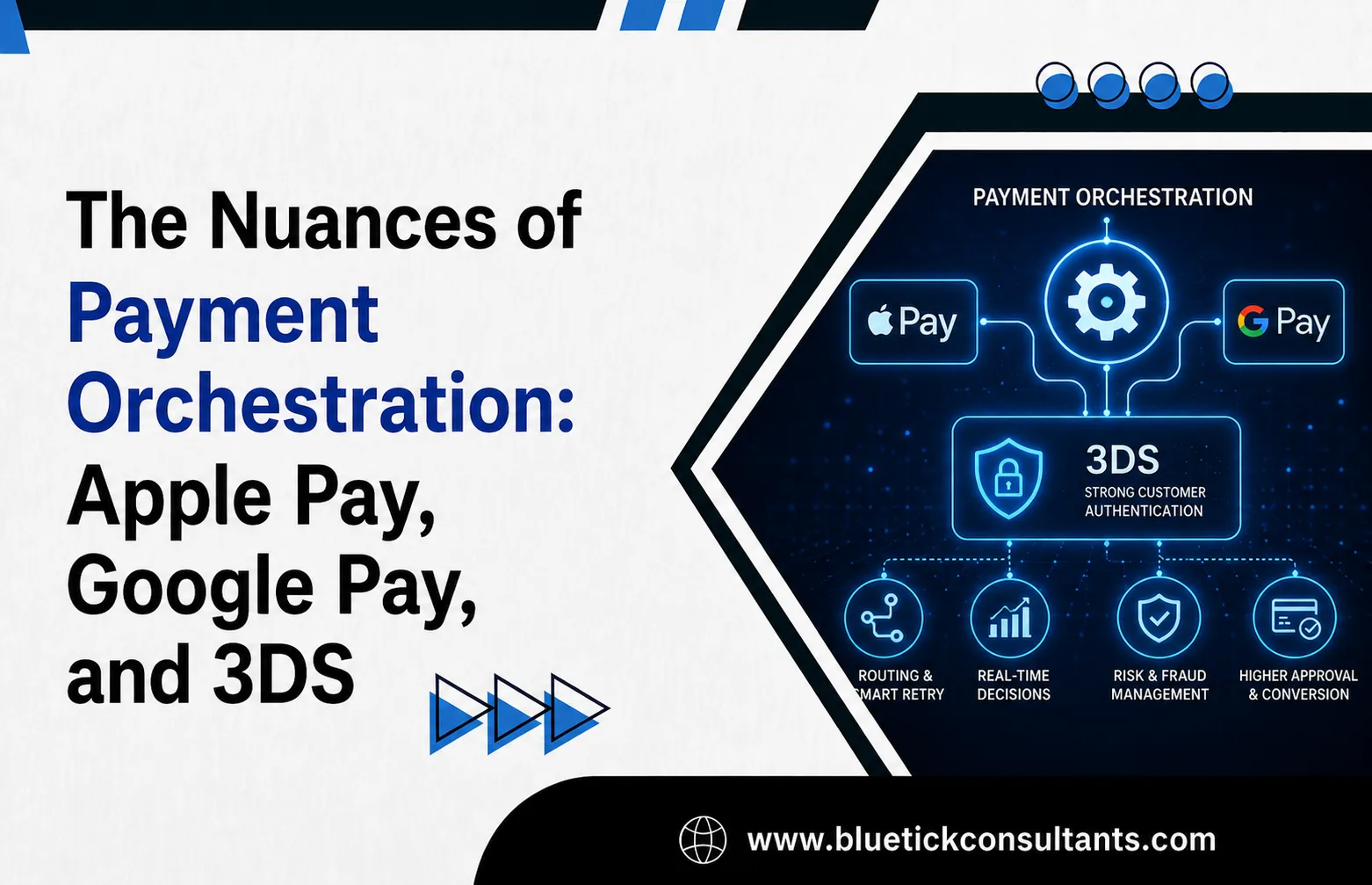
Payment orchestration looks simple on a slide: one API, many processors, smart routing, higher auth rates. In production, the hard parts are the methods that sit outside a plain card-not-present charge – wallets and authentication challenges. Apple Pay, Google Pay, and 3-D Secure (3DS) do not behave like “just another payment method” on your PSP. They change token formats, liability, UX, retry logic, and what your orchestrator is allowed to decide.
This post covers the nuances that matter when you design or operate an orchestration layer around those three.
Who this guide is for
This guide is written for payment engineers, fintech platform teams, e-commerce architects, and engineering leaders who are building or operating a multi-processor payment orchestration layer.
It is most useful when you are designing or improving payment flows that involve Apple Pay, Google Pay, and 3-D Secure (3DS / SCA), and when you need clear answers to these decisions:
- Can a failed wallet or 3DS attempt be safely retried on another processor?
- When should you step-up authentication instead of hopping to a different PSP?
- How should token formats, liability shift, and attempt state be modelled so routing rules do not create hard declines?
Primary use cases this guide supports:
- Designing multi-PSP payment orchestration
- Handling Apple Pay and Google Pay token routing
- Managing 3DS / SCA authentication and retries
- Reducing hard declines caused by incorrect wallet or 3DS failover logic
Industries: E-commerce, marketplaces, fintech platforms, and any business accepting cards + digital wallets under SCA or high-fraud environments.
What orchestration actually owns
A payment orchestrator sits between your checkout and one or more processors (Stripe, Adyen, Worldpay, local acquirers, etc.). Typical jobs:
- Method abstraction – present cards, wallets, and local methods through one merchant integration
- Routing – pick a processor by cost, auth rate, geo, MID health, or method support
- Failover – soft-decline retry on another processor without asking the shopper to re-enter details
- Reconciliation & reporting – normalize statuses, fees, and dispute signals
- Wallets and 3DS strain every one of those jobs. The orchestrator often cannot freely re-route a completed Apple Pay cryptogram or a finished 3DS challenge the way it can re-attempt a raw PAN authorization (and even PAN retries have network and SCA limits).
Rule of thumb: treat wallets and 3DS as stateful authentication + authorization contracts, not interchangeable rails.
Apple Pay: cryptograms, domains, and processor binding
What you actually receive
Apple Pay does not give you a reusable PAN you can freely shop around. You get a payment token (DPAN / device account number style credentials) plus a cryptogram and transaction metadata. That payload is meant for a specific merchant / processor context.
Nuances for orchestration:
- Processor affinity – Many setups decrypt or process the Apple Pay token at a specific PSP. If your orchestrator wants multi-PSP Apple Pay, you usually need either:
- separate merchant identifiers / payment processing certificates per processor, or
- a model where the orchestrator (or a vault partner) is the Apple Pay merchant and routes the resulting network token onward.
- Merchant validation is not optional theater – Domain association files, merchant ID registration, and session creation (
ApplePaySession) must match the environment the shopper sees. A misconfigured domain on one brand/subdomain silently kills wallet availability while cards still work – a common “orchestration looks down” false alarm. - Button UX is part of conversion – Apple requires using their button / sheet patterns. Orchestrators that invent a generic “Wallet” button and then branch to Apple Pay often fail review or confuse users. Method discovery (show Apple Pay only when
ApplePaySession.canMakePayments()/ active card checks pass) belongs in the client, not only in backend routing tables. - Billing / shipping contacts – Apple Pay can return contact fields your card form never collected. Orchestration and fraud stacks must accept incomplete address shapes and map them consistently so tax, shipping, and AVS do not disagree across processors.
- Recurring and merchant-initiated – Apple Pay for subscriptions and MIT flows has extra constraints (and evolving network rules). Do not assume a one-time Apple Pay auth gives you the same MIT flexibility as a card-on-file network token from a processor vault.
Orchestration implication
Failover after an Apple Pay decline is often not “send the same cryptogram to processor B.” Prefer:
- retry on the same processor with adjusted parameters (if soft decline), or
- fall back to another method (card form / Google Pay / local APM), or
- re-invoke Apple Pay for a fresh payload if the shopper is still in session
Blind cross-PSP replay of wallet payloads is a frequent source of hard declines and support tickets.
Google Pay: two token modes that look alike
Google Pay is easy to underestimate because the UI looks like one button. Under the hood, orchestration behavior splits on tokenization specification.
Gateway tokens vs. network tokens / direct
- PAYMENT_GATEWAY – Google returns a token encrypted for a named PSP gateway. Your orchestrator is effectively choosing that PSP before the sheet completes. Multi-PSP orchestration means multiple gateway configs, or accepting that Google Pay is pinned per attempt.
- DIRECT / network token style setups – You (or your orchestrator) decrypt with your own keys and can, in principle, route more flexibly – at the cost of PCI scope, key management, and certification burden.
Nuances:
- Allowed payment methods in the request – Card networks, auth methods (
PAN_ONLYvsCRYPTOGRAM_3DS), and billing address requirements change both conversion and risk. PAN_ONLY can behave closer to a card-on-file PAN (and may trigger 3DS / SCA differently than cryptogram-backed tokens). - Environment & merchant ID – Test vs production, merchant origin, and existing method requirements differ by platform (Android app, web, certain browsers). “Works on Chrome Android, missing on Safari desktop” is often configuration, not orchestration routing.
- 3DS interaction – Cryptogram-backed Google Pay credentials may already carry device-binding signals. Forcing a full 3DS challenge on every Google Pay auth can hurt conversion without buying proportional fraud reduction. Your orchestrator’s risk rules should distinguish wallet cryptogram auths from raw PAN entry.
- Country and processor coverage – Google Pay availability and supported networks vary. Orchestration “smart routing” must filter processors by actual Google Pay support for that MID and region, not by generic card acquiring support.
Orchestration implication
Decide early whether Google Pay is:
- PSP-pinned (simpler, common): orchestrator selects PSP → client requests Google Pay for that gateway → authorize on that PSP only, or
- orchestrator-decrypted (flexible, heavier): orchestrator owns keys / compliance → can route the resulting credentials with clearer rules
Mixing both models without documenting the attempt state machine creates impossible retries.
Is 3DS the same as authorization?
3DS proves who the shopper is; it does not authorize the charge. Attaching the authentication result to the authorization correctly is what preserves liability shift and avoids issuer declines.
3-D Secure (especially EMV 3DS / 3DS2) is an authentication protocol between merchant/requestor, directory server, and issuer ACS. Orchestration teams often collapse it into “extra redirect that reduces chargebacks.” The nuances are sharper.
Frictionless vs challenge
Issuers can:
- Frictionless – authenticate based on risk data with no shopper UI
- Challenge – OTP, banking app, biometrics, etc.
Your orchestrator must preserve:
- authentication path (
transStatusvalues like Y / A / N / U / R / C, depending on version and mapping) - ECI / CAVV (or AVV) / dsTransID / threeDSServerTransID
- version (2.1.0 vs 2.2.0 matters for data and exemptions)
Authorization without correctly attaching authentication data is how you lose liability shift and get issuer declines.
SCA, exemptions, and TRA
In regulated regions (notably PSD2 SCA in Europe), 3DS is entangled with:
- Low-value exemptions
- Transaction Risk Analysis (TRA)
- Trusted beneficiaries (allowlisting)
- MIT / recurring out-of-scope or one-leg-out cases
An orchestrator that always “does 3DS” or never does can both be wrong. Optimal policy is usually:
- Risk engine proposes challenge / frictionless / exemption
- Processor / 3DS server executes
- Auth result feeds authorization
- Soft declines like “soft decline – authenticate” (
soft decline/1Zstyle issuer guidance, processor-specific codes) trigger a step-up, not a blind processor hop
Cross-processor 3DS
This is the sharp edge of orchestration:
- A 3DS authentication completed with Processor A’s 3DS server is generally not portable to Processor B’s authorization.
- Re-routing after challenge completion usually means re-authenticating, which means more friction and possible shopper drop-off.
- Some vault / network token strategies reduce pain for retries, but they do not magically make ACS results universal.
Design for attempt-scoped authentication: bind attempt_id → processor → 3DS result → auth. Failover rules should know whether a new 3DS is required.
Data quality decides frictionless rates
3DS2 expects a rich browser and, where applicable, app SDK data (accept headers, viewport, IP, device channels, etc.). Orchestrators that proxy checkout through multiple frontends or WebViews often strip fields and accidentally force challenges. Measure challenge rate and frictionless rate per channel, not only overall auth rate.
How the three collide in one checkout
Real checkouts combine these paths:
| Shopper path | Authn signal | Orchestration constraint |
| Card + 3DS challenge | CAVV / ECI from ACS | Sticky to 3DS-performing processor for that attempt |
| Apple Pay | Device cryptogram | Often sticky to Apple Pay merchant/PSP config |
| Google Pay (gateway) | Gateway-encrypted token | Sticky to chosen gateway PSP |
| Google Pay (PAN_ONLY) | May still need 3DS / SCA | Treat closer to card + possible step-up |
| Card exemption / TRA | Possibly no challenge | Document exemption; monitor dispute liability |
Liability shift is not binary marketing copy
Liability shift depends on method, region, network, authentication result, and merchant category. Apple Pay / Google Pay cryptogram transactions and successful 3DS can each shift liability under conditions – but fraud tools, friendlier fraud, and certain MCCs still leave residual risk. Orchestration reporting should separate:
- authenticated vs not
- wallet vs PAN
- challenged vs frictionless
- exemption claimed vs authenticated
Otherwise finance and risk argue from different truths.
Practical design principles for orchestrators
- Model payment method as a state machine, not a string enum. States like
WalletSessionCreated,TokenReceived,ThreeDSMethodUrl,Challenged,Authenticated,Authorized,SoftDeclinedNeedsStepUpprevent illegal transitions (e.g., “route elsewhere after challenge”). - Separate method eligibility from processor routing. Eligibility: can this shopper use Apple Pay here? Routing: which MID should take this attempt? Google Pay gateway selection often is routing.
- Prefer step-up over hop when the decline reason is authentication-related. Prefer hop when the decline is acquirer/MID health related and you still have routable credentials.
- Normalize decline taxonomy across PSPs – especially soft decline / SCA required / do not honor / lost-stolen. Raw processor codes are not an orchestration policy.
- Keep client SDKs honest. Apple Pay and Google Pay need client-side capability checks; 3DS needs correct browser data and challenge windows (including iframes, pop-ups, and native SDK UI). Backend-only orchestration cannot fix a broken challenge UX.
- Test the ugly paths: challenge cancel, challenge timeout, Apple Pay sheet dismiss, Google Pay
STATUS_CANCELED, partial address, and “auth success / authz fail.” Those dominate real abandonment more than happy-path auth rates.
What “good” looks like
Teams that handle these nuances well usually share outcomes:
- Wallet and 3DS attempts are attempt-scoped with clear processor binding
- Retries are reason-aware (step-up vs re-route vs new wallet sheet)
- Risk policy treats cryptogram wallets differently from typed PANs
- Product analytics track sheet open → authorized funnels separately from card forms
- Compliance and domain/merchant setup are monitored like uptime, not like one-time onboarding
Payment orchestration creates leverage only when it respects the contracts of the methods it routes. Apple Pay, Google Pay, and 3DS are not edge cases — they are where conversion, liability, and authorization integrity are won or lost.
Further reading (implementation checklists)
- Confirm Apple Pay merchant IDs, domains, and certs per PSP or orchestrator model
- Document Google Pay
PAYMENT_GATEWAYvsDIRECTchoice and retry rules - Map processor soft-decline codes to step-up 3DS vs failover
- Store and forward 3DS cryptograms/ECI with the matching authorization only
- Alert on spikes in challenge rate, wallet cancel rate, and authz fails after successful authn
Frequently Asked Questions
Do Apple Pay and Google Pay work across multiple payment processors?
No, not freely. Apple Pay and Google Pay credentials are generally bound to the merchant and processor context in which they are requested. An Apple Pay cryptogram or a PAYMENT_GATEWAY-encrypted Google Pay token is typically intended for a specific PSP.
Supporting multiple processors usually requires separate merchant IDs, certificates, or gateway configurations for each processor. Alternatively, an orchestrator or vault partner can hold the wallet-merchant role and route the resulting network token onward.
Because wallet credentials are not interchangeable like raw card details, replaying a completed Apple Pay or Google Pay payload against another processor can result in a hard decline. Payment orchestration should therefore treat wallet attempts as processor-aware and attempt-scoped.
Does Google Pay always require 3DS?
No, Google Pay does not always require 3DS. The requirement depends on the authentication method carried by the Google Pay token, the transaction’s risk profile, and applicable SCA requirements.
A CRYPTOGRAM_3DS token is device-bound and already carries 3-D Secure authentication signals. Forcing an additional full 3DS challenge in every case can add unnecessary friction and reduce conversion without providing proportional fraud protection.
A PAN_ONLY token behaves more like a stored card credential and may require 3DS or SCA separately. The payment orchestrator should therefore distinguish between CRYPTOGRAM_3DS and PAN_ONLY rather than applying the same 3DS policy to every Google Pay transaction.
Why does a payment retry succeed on one processor but fail on another after 3DS?
Because a completed 3DS authentication is generally tied to the processor and 3DS server that performed the authentication. The authentication result cannot always be transferred directly to another processor’s authorization request.
For example, if Processor A performs the 3DS challenge and the authorization subsequently fails, sending the same authenticated transaction directly to Processor B may fail because Processor B cannot necessarily use Processor A’s authentication result.
Re-routing after a completed challenge may therefore require a fresh authentication, which introduces additional friction and potential shopper drop-off.
The safer approach is to use attempt-scoped payment orchestration: bind the attempt_id to the processor, 3DS result, and authorization together. Failover rules should understand whether the transaction can be retried directly or requires a new authentication step.
Does using a digital wallet or 3DS guarantee chargeback protection?
No, using a digital wallet or 3DS does not guarantee chargeback protection. Liability shift depends on the payment method, region, card network, authentication result, and merchant category.
Cryptogram-backed Apple Pay and Google Pay transactions, as well as successfully authenticated 3DS transactions, can provide liability-shift benefits when the applicable conditions are met. However, liability shift is not automatic and does not eliminate all dispute or fraud exposure.
Friendly fraud, certain merchant category codes, authentication outcomes, and network-specific rules can still result in merchant liability.
For accurate risk reporting, payment orchestration systems should distinguish between:
- Authenticated vs. unauthenticated transactions
- Wallet vs. PAN payments
- Challenged vs. frictionless 3DS
- Exemption-based vs. authenticated transactions
This gives risk and finance teams a consistent view of authentication, authorization, and dispute exposure.
Need an architecture review of your wallet & 3DS orchestration?
Most teams discover gaps only after hard declines or failed Apple Pay domain validation.
Book a focused architecture review of your current routing, retry, and authentication state machine.