Published: | Last Updated:
Key Takeaway: OpenAI Daybreak Red and Blue are now available on Amazon Bedrock for eligible enterprise customers. In summary, Daybreak Blue (GPT-5.6 Sol) is purpose-built for defensive security workflows including incident response and vulnerability discovery, while Daybreak Red
(GPT-5.6 Cyber) is purpose-trained for authorized vulnerability research and exploit validation. Bottom line: Importantly, both models run with zero-operator access enforced at the chip level – OpenAI never receives your data and never used for model training.
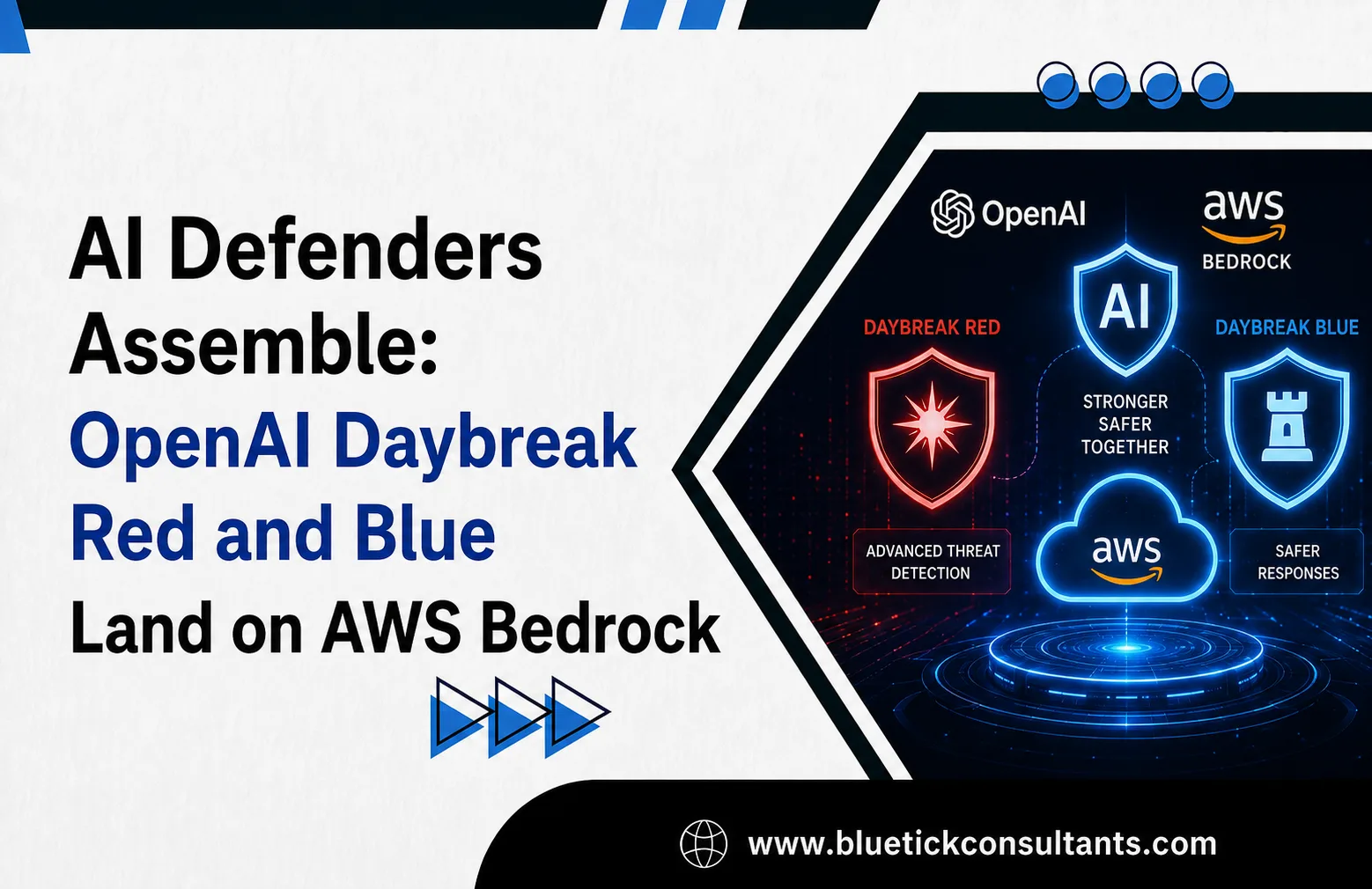
AWS and OpenAI have officially joined forces to revolutionize enterprise cyber defense by launching OpenAI’s specialized Daybreak models on Amazon Bedrock. This launch introduces two tailored access tiers: Daybreak Blue (GPT-5.6 Sol) and Daybreak Red (GPT-5.6 Cyber). Both are available to eligible customers in the US East (Ohio) region and built to accelerate threat detection, incident response, and authorized vulnerability research inside a hardware-isolated environment.
The Two Faces of Daybreak: Blue vs. Red
Standard commercial AI models often refuse legitimate dual-use security tasks due to strict safety guardrails. Daybreak addresses this directly, providing vetted defenders with calibrated intelligence tiers matched to their operational needs.
| Feature | Daybreak Blue (GPT-5.6 Sol) | Daybreak Red (GPT-5.6 Cyber) |
| Primary Focus | General-purpose defensive workflows | Advanced vulnerability research & exploit validation |
| Refusal Threshold | Standard defensive calibration | Lowered for authorized deep technical tasks |
| Core Use Cases | Incident response, patching, discovery | Exploit reproduction, red teaming |
| Enterprise Governance | OpenAI Daybreak Access Program | Separately approved specialist path + extra verification |
Practical Example 1: Streamlining Incident Response with Daybreak Blue
Consider a mid-sized financial enterprise facing a potential security breach. The Security Operations Center (SOC) team detects a sudden anomaly: an internal server is communicating with an unknown external IP address using an unusual, obfuscated PowerShell script.
The Workflow
- Log Analysis: First, the analyst feeds the raw, obfuscated PowerShell script and the relevant endpoint telemetry logs into an automated pipeline powered by Daybreak Blue via Amazon Bedrock.
- De-obfuscation & Triage: Next, utilizing GPT-5.6 Sol, the model instantly de-obfuscates the code, mapping the script’s behavior directly to the MITRE ATT&CK framework (e.g., identifying it as a Living off the Land attack technique).
- Remediation Loop: Finally, Daybreak Blue drafts a localized firewall rule to block the malicious external IP, generates an AWS IAM policy amendment to restrict the compromised server’s permissions, and writes a draft incident summary for the leadership team.
Why it matters: As a result, what typically takes an incident responder hours of manual reverse engineering happens in under two minutes, stopping lateral movement before it starts.
Practical Example 2: Validating a Zero-Day Patch with Daybreak Red
Consider this: an enterprise software provider receives a private disclosure about a critical remote code execution (RCE) vulnerability in their main application. Before they can ship a patch, they must reproduce the exploit to ensure their fix actually blocks it. Standard LLMs would completely refuse to help create or validate an exploit payload.
The Workflow
- Exploit Reproduction: An authorized security researcher uses Daybreak Red (GPT-5.6 Cyber). Daybreak Red features a lower refusal threshold for trusted partners.
The model analyzes the raw crash dump and generates a proof-of-concept
(PoC) exploit payload to confirm the vulnerability’s impact. - Code Remediation: The developers write a patch to sanitize the vulnerable input fields.
- Validation Testing: Subsequently, the researcher feeds the new patch back to Daybreak Red and asks it to modify the exploit payload to try and bypass the new defenses. The model tests the code aggressively, completing the legitimate dual-use task successfully and confirming that the patch entirely neutralizes the vulnerability.
Why it matters: Notably, according to early performance benchmarks, GPT-5.6 Cyber successfully completes 95% of legitimate dual-use security tasks, compared to a mere 1.5–2% success rate from standard, heavily restricted models.
Under the Hood: AWS Enclaves and Hardware-Enforced Privacy
Deploying these models through Amazon Bedrock addresses the primary concern of enterprise security leaders: data privacy. The architecture is engineered around absolute isolation:
- Zero-Operator Access: Specifically, the models run on AWS next-generation inference engines with hardware-enforced isolation at the silicon chip level via AWS Nitro Enclaves. Specifically, no human operator—not even an AWS engineer—can view your active session data.
- No Training on Enterprise Data: Furthermore, your prompts, internal logs, proprietary code, and sensitive vulnerability findings stay within your private AWS environment. Moreover, data is never shared with OpenAI and OpenAI never uses it to train future models.
- Zero Data Retention: Eligible enterprises can actively request a strict zero-data-retention policy for absolute operational compliance.
The Strategic Impact: Shifting from Reactive to Predictive Defense
Overall, the arrival of Daybreak on Amazon Bedrock marks a fundamental shift in how modern enterprises manage risk. By transitioning away from brittle, signature-based detection systems, organizations unlock major strategic advantages:
- Eliminating the Cyber Skills Gap: Tier-1 and Tier-2 SOC analysts can use Daybreak Blue to handle complex reverse engineering and log correlation tasks, acting as a massive force multiplier for understaffed teams.
- Continuous Red Teaming: Annual external audits are no longer sufficient. With Daybreak Red,
internal researchers can run continuous, automated exploit simulations to
evaluate real-time architectural resilience. - Drastically Reduced Blast Radii: Consequently, automating the chain from discovery to patch mitigation delivers measurable results. Enterprises can shrink their Mean Time to Remediation
(MTTR) from days to single-digit minutes.
Would you like me to tailor this expanded post further? I can:
- Add a technical section with actual sample prompts used for Daybreak Blue and Red.
- Create a Boto3 Python code snippet showing how to invoke these models via the Bedrock API.
- Generate a custom visual image prompt for your blog’s cover graphic.
Security teams can apply for enrollment in Daybreak access directly through OpenAI.
Frequently Asked Questions
What is OpenAI Daybreak and how does it differ from standard AI models?
In short, OpenAI Daybreak is a cyber defense initiative that gives vetted security professionals governed access to frontier AI models. Unlike standard commercial AI models that refuse legitimate dual-use security tasks due to strict safety guardrails, Daybreak provides calibrated access tiers – Blue for defensive workflows and Red for advanced vulnerability research – matched with strong identity verification and access controls.
What is the difference between Daybreak Blue and Daybreak Red?
Specifically, Daybreak Blue provides access to GPT-5.6 Sol with safeguards calibrated for defensive security work such as incident response, vulnerability discovery, and detection engineering. Daybreak Red provides access to GPT-5.6 Cyber, a purpose-trained cybersecurity model with a lower refusal threshold designed for authorized tasks such as exploit reproduction, red teaming, and zero-day patch validation. Daybreak Red requires a separately approved specialist path with additional verification.
How do I get access to Daybreak Red and Blue on Amazon Bedrock?
To get started, access requires enrollment in OpenAI’s Trusted Access for Cyber program. Once approved by OpenAI, you work with your AWS account team to request model access on Bedrock. The models are currently available to eligible customers in the US East (Ohio) region.
Is enterprise data safe when using Daybreak models on Amazon Bedrock?
Yes. To be clear, both models run on Bedrock’s next-generation inference engine with zero-operator access enforced at the chip level, meaning no AWS engineer or operator can view your active session data. Your prompts, internal logs, and vulnerability findings OpenAI never accesses your findings and are never used to train future models. Additionally, eligible enterprises can also request a zero-data-retention policy.
Can Daybreak Red be used to create malicious exploits?
No. Access to Daybreak Red requires passing through OpenAI’s Trusted Access for Cyber identity and trust framework, which includes identity verification, account security monitoring, approved-use restrictions, and legal attestations. Starting September 1, 2026, all individual Daybreak accounts must also adopt hardware security keys. In other words, the lower refusal threshold is specifically calibrated for authorized defensive research, not offensive use.
How does Daybreak Blue help SOC teams with incident response?
Daybreak Blue can de-obfuscate malicious scripts, map attacker behavior to the MITRE ATT&CK framework, draft firewall rules to block malicious IPs, generate IAM policy amendments, and produce incident summaries — tasks that typically take hours of manual analysis can be completed in under two minutes, acting as a force multiplier for understaffed security teams.
What performance benchmarks has GPT-5.6 Cyber demonstrated?
According to OpenAI’s early performance benchmarks, Notably, GPT-5.6 Cyber successfully completes 95% of legitimate dual-use security tasks, compared to a 1.5–2% success rate from standard heavily restricted models.