Published: 3 | Updated: 3
The short answer: Agentic AI digital coworkers can now operate software that offers no other way in, by looking at the screen and clicking. Two credible products launched in August 2026 – Grok Bot from xAI and Warmwind OS from Warmwind AG. Agentic AI cost is unpredictable by design: Warmwind was listed at 1 euro per worker hour, Grok Bot has no standalone price and bills overflow by the token. Reliability is the harder problem. At 85 percent accuracy per step, a ten-step job finishes cleanly about one time in five. Gartner expects over 40 percent of agentic AI projects to be cancelled by the end of 2027. Use these tools for short, bounded jobs with a checkable result – not long unattended chains.
The problem
You asked an AI chatbot to help you with your expense claims. It wrote you a lovely set of instructions. Then you went and did all the clicking yourself.
That is the shape of the complaint. The assistant is clever, and it is also sitting on its hands. It can tell you what to do, draft the email, explain the spreadsheet formula. It cannot open your accounting software, find last month’s invoices, and file them. So the boring part, the part that eats the afternoon, still lands on you.
The gap has a simple cause. Most AI tools are built to answer, then stop. Every step needs you to come back and ask again. If a job has thirty steps, you are the one carrying it between them.
What we are solving
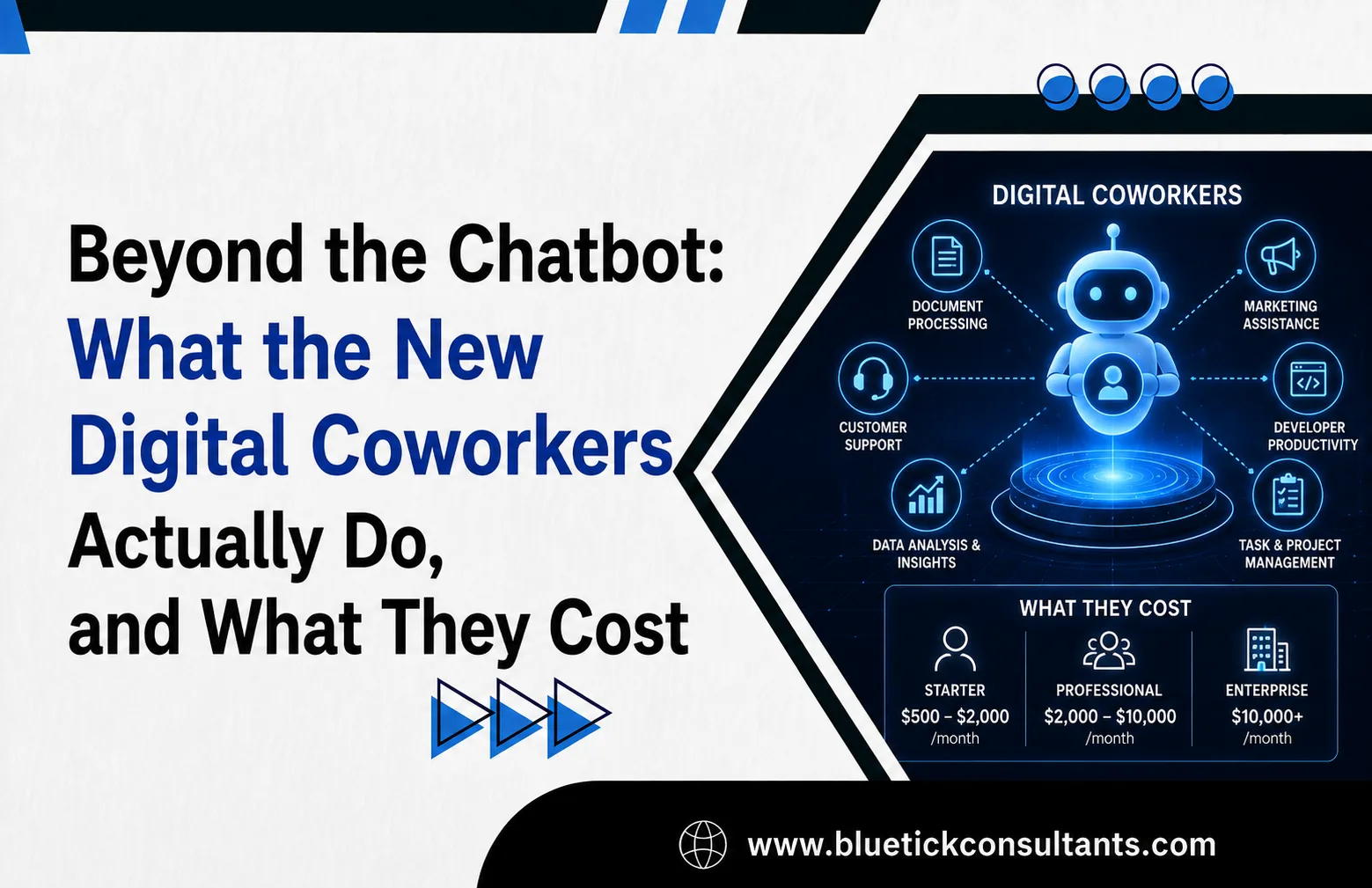
A new kind of product tries to close that gap. Instead of answering and stopping, it gets its own computer in the cloud and works on the job in the background.
- It has a screen, a keyboard and a mouse, just like you do, plus its own web browser and file storage.
- You give it a whole task, not a single question. Something like: pull last week’s orders, check them against the invoices, and flag the mismatches.
- It keeps going while your laptop is shut. The work happens on a machine in a data centre, not on your desk.
- It comes back to you when it needs a decision, a password, or permission to send something.
The industry calls these agents, digital coworkers, or cloud employees. The plain version: software that does the clicking instead of describing it.
Two things this does not solve, and they matter more than the marketing suggests:
- It does not remove the need to check the work. Someone still reviews what came out, especially for anything involving money or customers.
- It does not make a messy process tidy. If your current workflow only works because a human quietly fixes things, handing it to an agent hands over the mess too.
A real example
Two products launched within a fortnight of each other in August 2026, and they take noticeably different routes to the same idea.
Grok Bot, from xAI
- Launched in beta on 11 August 2026, then widened across subscription plans through the rest of the month.
- Each user gets one persistent cloud computer with a browser, a filesystem and a terminal. Your bots share it.
- It prefers a proper connection to an app where one exists, and falls back to driving the screen only for tools that offer no clean way in. This matters: it is a hybrid, not a pure screen-driver.
- You can show it a job once by recording a browser session of up to ten minutes, and it saves that as a routine it can repeat on a schedule.
- It runs on macOS, Windows and iPhone. There is no Linux, Android or iPad version at launch.
Warmwind OS, from Warmwind AG in Jena, Germany
- Version 1.0 launched publicly on 26 August 2026, after a closed beta with a waitlist reported at over 12,000 people.
- This one is the pure screen-driver. Each worker gets a Linux desktop in the cloud and operates ordinary software by looking at the screen and using a mouse and keyboard. No integrations required.
- That is the whole pitch: it can drive old, ugly business software that has no modern way to connect to it. The launch video demonstrates exactly that, on legacy German rental-management software.
- The company runs on German cloud infrastructure and leans hard on European data-protection rules as a selling point, which matters to firms that cannot send recordings of their screens to an American provider.
Both companies use the phrase visual navigation. Only Warmwind, however, means it literally for everything. Judge each on which of your tools it can actually reach, because that is where the difference shows up.
How it works, and the maths that decides whether it helps
The mechanics are less interesting than the arithmetic. An agent working through a long job has to get every step right in a row. As a result, small error rates compound fast.
How reliable is a multi-step AI agent?
Here is the calculation. It is short enough to read and you can run it yourself:
"""How often does a multi-step agent finish a whole job correctly?"""


def end_to_end(step_accuracy, steps):
    """Chance all steps succeed in a row, as a percentage."""
    return step_accuracy**steps * 100


def steps_before_coinflip(step_accuracy):
    """How many steps until the job is likelier to fail than succeed."""
    steps = 1
    while end_to_end(step_accuracy, steps) >= 50:
        steps += 1
    return steps


for accuracy in (0.85, 0.95, 0.99):
    print(f"\nAgent is {accuracy:.0%} accurate on each single step:")
    for steps in (5, 10, 20, 50):
        clean = end_to_end(accuracy, steps)
        print(f"  {steps:>2} steps -> {clean:5.1f}% finish clean")
    print(f"  coin flip at {steps_before_coinflip(accuracy)} steps")
Running it prints this:
Agent is 85% accurate on each single step:
   5 steps ->  44.4% finish clean
  10 steps ->  19.7% finish clean
  20 steps ->   3.9% finish clean
  50 steps ->   0.0% finish clean
  coin flip at 5 steps

Agent is 95% accurate on each single step:
   5 steps ->  77.4% finish clean
  10 steps ->  59.9% finish clean
  20 steps ->  35.8% finish clean
  50 steps ->   7.7% finish clean
  coin flip at 14 steps

Agent is 99% accurate on each single step:
   5 steps ->  95.1% finish clean
  10 steps ->  90.4% finish clean
  20 steps ->  81.8% finish clean
  50 steps ->  60.5% finish clean
  coin flip at 69 steps
What those numbers mean in practice
In plain words, for anyone who skipped the code:
- An agent that gets 85 out of 100 individual clicks right finishes a ten-step job cleanly about one time in five.
- Push it to 95 out of 100 and the same ten-step job works about six times in ten. Better, still not something you would leave unwatched.
- You need roughly 99 out of 100 before long jobs hold together, and even then a fifty-step job fails about four times in ten.
- This is why the demos look magical and the rollouts disappoint. A demo is a short job. Your actual work is a long one.
It also tells you how to use these tools well. Short, bounded jobs with a checkable result are where they pay off. Long unattended chains, by contrast, are where they quietly burn money.
What it costs
Prices below were checked on 2 September 2026. This corner of the market is repricing constantly, so treat these as a starting point and confirm before you buy.
| Option | Upfront cost | Ongoing cost | Hidden costs | Best for |
|---|---|---|---|---|
| Carry on as you are | None | None in cash | The hours themselves. Work that only one person knows how to do. | Anyone whose repetitive work is under a few hours a week |
| Grok Bot (xAI) | None | No standalone plan. Bundled into SuperGrok Plus and Heavy, and Cursor Pro Plus, Ultra and Teams tiers. Plans include a weekly allowance. | Usage past the allowance is billed from model and token cost. Grok 4.6 runs $2 per million input tokens and $6 per million output, doubling above 200k tokens. Reports say there is no product-specific spend cap yet. | Individuals already paying for one of those plans |
| Warmwind OS | None | Listed at 1 euro per hour of worker time when checked on 27 August 2026, with a launch promotion at half price. | Idle time still counts as worker time. Screen-driven runs are slower than direct connections, so the same job burns more minutes. | Smaller firms with old software and European data rules to satisfy |
| Traditional RPA (UiPath and similar) | Consultant setup, often weeks | Per-licence, quoted by sales | Breaks whenever a screen layout changes. Needs someone on staff to maintain it. | Large, stable, high-volume processes |
Three things to take from the table:
- Nobody publishes a number you can plan against. Warmwind gives an hourly rate but the hours depend on how slow the screen work is. Grok Bot gives no separate price at all, only an allowance inside a bundle.
- Hourly and token billing means the bill scales with how badly the agent struggles. A job that goes wrong twice costs three times as much as one that works.
- Even so, free trials do not tell you the running cost. The published guidance is to treat the first month as an experiment, not a budget line.
Pros and cons
What genuinely works
- Reaches software that has no other way in. This is the real advance. Old systems that no integration ever supported can now be driven.
- Setup is also quick. No consultant, no integration project. You describe the job or record yourself doing it once.
- Work continues without you. Overnight jobs finish while your machine is off.
- Teaching by demonstration is far easier than writing rules, and it is how both products expect you to start.
What genuinely does not
- Reliability compounds badly, as the numbers above show. This is the central limitation and no vendor has solved it.
- Screen-watching is also fragile by nature. A redesigned page, a pop-up, a slow load, or an unexpected login prompt can derail a run that worked yesterday.
- Costs are hard to predict and, in at least one case, hard to cap.
- Weak isolation between agents. xAI’s own documentation states the cloud computer belongs to your account rather than to each bot, and warns explicitly against using separate bots as a security boundary. Logins and files are shared across all of them.
- The analyst forecasts point the other way from the hype. Gartner expects more than 40 percent of agentic AI projects to be cancelled by the end of 2027, citing runaway costs, unclear value and weak risk controls. Surveys through 2026 repeatedly found most pilots never reaching production.
On that last point, one correction to a claim you will see everywhere. 2027 is being sold as the year these tools take over. The evidence available today points instead to 2027 being the year the weaker projects get cancelled. Both things can be true: the technology is real and improving, and most attempts to deploy it will still fail. Pick your jobs accordingly.
Key takeaways
- These tools are genuinely new in one respect: they can operate software that offers no other way in, by looking at the screen and clicking.
- Two credible products launched in August 2026. Warmwind OS drives the screen for everything. Grok Bot prefers a direct connection and only drives the screen when it must.
- Reliability compounds. At 85 percent per step, a ten-step job finishes cleanly about one time in five. Short, checkable jobs are where these tools earn their keep.
- Costs are unpredictable by design. Warmwind was listed at 1 euro per worker hour in late August 2026. Grok Bot has no standalone price and bills overflow usage by the token.
- Nobody has solved supervision. Budget for someone to check the output, and do not point an agent at anything expensive without an approval step.
- Gartner expects over 40 percent of agentic AI projects to be cancelled by the end of 2027. Start with one small job you can verify, not a department-wide rollout.
Frequently Asked Questions
What is an agentic AI digital coworker?
It is software that gets its own computer in the cloud, with a browser, filesystem and
screen, and completes a whole multi-step task rather than answering a single question. It works
in the background while your own machine is off, and returns to you when it needs a decision, a
password or permission to send something.
How much does agentic AI cost in 2026?
Neither major product publishes a number you can plan against. Warmwind OS was listed at 1
euro per hour of worker time when checked on 27 August 2026, with a launch promotion at half
price. Grok Bot has no standalone plan at all; it is bundled into SuperGrok Plus and Heavy and
Cursor Pro tiers with a weekly allowance, and overflow usage is billed at Grok 4.6 token rates
of 2 dollars per million input tokens and 6 dollars per million output. Because billing is
hourly or per token, the bill scales with how badly the agent struggles.
Why do agentic AI agents fail on long tasks?
Accuracy compounds across steps. An agent that is 85 percent accurate on each individual step
finishes a ten-step job cleanly only about one time in five, and reaches a coin flip at five
steps. At 95 percent accuracy a ten-step job works about six times in ten. You need roughly 99
percent per step before long jobs hold together, and even then a fifty-step job fails about four
times in ten. This is why demos, which are short jobs, look magical while real rollouts
disappoint.
Should we choose Grok Bot or Warmwind OS?
Judge each on which of your tools it can actually reach. Grok Bot is a hybrid: it prefers a
proper connection to an app where one exists and drives the screen only as a fallback, and it
runs on macOS, Windows and iPhone with no Linux, Android or iPad version at launch. Warmwind OS
is a pure screen-driver on a cloud Linux desktop, needs no integrations, and is the stronger fit
for old business software and for firms bound by European data-protection rules.
Is 2027 the year agentic AI takes over?
The evidence available today points the other way. Gartner expects more than 40 percent of
agentic AI projects to be cancelled by the end of 2027, citing runaway costs, unclear value and
weak risk controls. Both things can be true at once: the technology is real and improving, and
most attempts to deploy it will still fail. Start with one small job you can verify rather than
a department-wide rollout.
What does agentic AI not solve?
Two things. It does not remove the need to check the work, especially where money or
customers are involved, so budget for a human reviewer and an approval step. And it does not
make a messy process tidy: if a workflow only works because a person quietly fixes things,
handing it to an agent hands over the mess too.