The Rise of Intelligent Backend Systems in the AI Era
For years, backend engineering was largely about building APIs, writing business logic, optimizing databases, and scaling services.
But in 2026, backend systems are evolving into something much bigger.
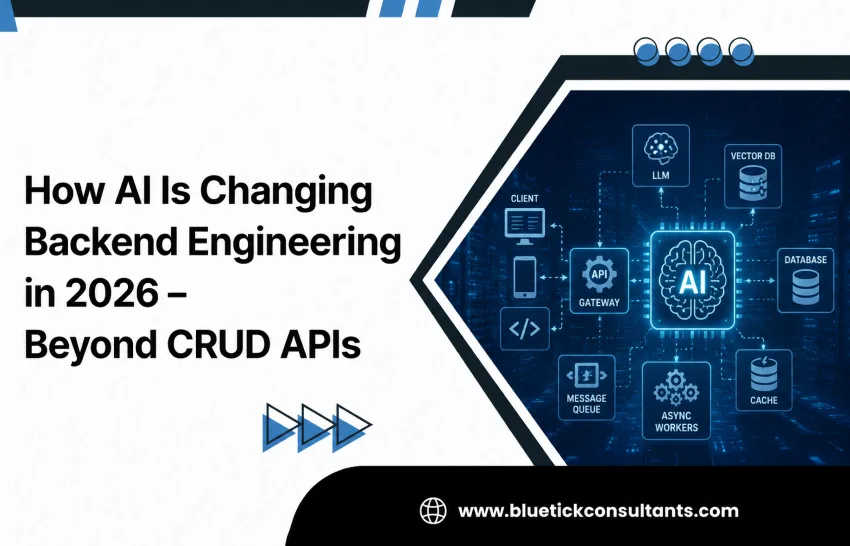
AI is transforming backends from passive data-processing layers into intelligent systems capable of reasoning, automation, semantic search, and decision support. Modern backend services are no longer just returning JSON responses, they are orchestrating LLMs, vector databases, asynchronous workflows, and AI-powered business operations.
And that shift is fundamentally changing what backend engineering means.
From CRUD APIs to Intelligent Backend Systems
Traditional backend architecture followed a familiar flow:
Frontend → API → Business Logic → Database
Most engineering effort went into:
- CRUD APIs
- authentication
- serializers
- ORM optimization
- caching
- queue processing
- integrations
Frameworks like Django and FastAPI made building scalable APIs faster and more structured.
Today, however, enterprise systems are increasingly embedding AI directly into backend workflows.
Modern backend systems now handle:
- semantic search
- AI recommendations
- intelligent automation
- document understanding
- AI copilots
- autonomous workflows
- retrieval-augmented generation (RAG)
- workflow summarization
- AI-assisted decision making
The backend is becoming the intelligence layer of the application.
The Rise of AI-Native Backend Architecture
AI-powered applications require a different kind of architecture.
A modern AI backend stack often looks like this:
Client App
↓
FastAPI / Django APIs
↓
AI Orchestration Layer
↓
LLMs + Vector Database + Business Systems
↓
Celery Workers + Redis Queues
This introduces technologies backend engineers traditionally didn’t work with regularly:
- vector databases
- embeddings
- AI orchestration layers
- inference pipelines
- semantic retrieval systems
- prompt management systems
- model evaluation layers
For example, in an AI-powered ERP workflow:
- A user uploads documents
- Backend services process files asynchronously
- AI extracts structured information
- Vector search retrieves similar records
- LLMs generate recommendations
- Business rules validate the output
- Audit logs store AI decisions for compliance
This is no longer just backend development. It is AI system architecture.
AI Is Changing API Design Itself
One interesting shift happening in AI backend engineering is the evolution of APIs.
Traditional APIs were deterministic:
- request in
- response out
AI-powered APIs are contextual and adaptive.
For example:
- recommendation APIs personalize outputs dynamically
- AI search APIs understand intent instead of keywords
- support APIs summarize conversations automatically
- analytics APIs generate insights instead of raw data
This changes how backend engineers think about:
- API contracts
- caching strategies
- response consistency
- latency management
- observability
The backend is moving from data-serving systems to decision-serving systems.
What AI Can Already Automate
AI is rapidly automating repetitive backend work.
Today, AI tools can generate:
- CRUD endpoints
- serializers
- boilerplate APIs
- documentation
- migration scripts
- unit test scaffolding
- SQL queries
- repetitive validation logic
A senior engineer can now build the first version of an API in minutes instead of hours.This significantly improves development speed.But generated code is not production engineering.
What Still Requires Senior Backend Engineers
AI can generate implementation code. It still cannot reliably handle engineering tradeoffs.
The hardest backend problems still require experienced engineers:
- distributed systems design
- scalability planning
- security architecture
- database optimization
- observability
- reliability engineering
- async orchestration
- domain modeling
- event-driven architecture decisions
Production AI systems introduce entirely new challenges:
- hallucinations
- token costs
- AI API latency
- prompt injection attacks
- inconsistent outputs
- monitoring AI workflows
- vendor lock-in risks
For example, a poorly designed AI-powered API can create:
- massive infrastructure costs
- slow response times
- unpredictable outputs
- security vulnerabilities
That is why backend engineering is becoming more architectural, not less.
Why Async Processing Is Becoming Critical
AI workloads are rarely lightweight.
Inference requests often take significantly longer than traditional database queries.
This is why async architectures are becoming the backbone of scalable AI systems.
Tools like:
are becoming essential for:
- document processing
- AI inference pipelines
- recommendation generation
- batch embedding creation
- large-scale notifications
- AI evaluation jobs
Without proper async orchestration, AI applications quickly become slow and expensive.
Why Backend Engineers Must Learn AI Concepts
One of the biggest misconceptions right now is that AI belongs only to ML engineers.In reality, most enterprise AI systems eventually become backend systems problems.
Backend engineers now need practical understanding of:
- embeddings
- vector search
- RAG architectures
- LLM APIs
- AI orchestration
- prompt engineering
- AI observability
- inference optimization
Not to become AI researchers — but to build scalable AI systems responsibly.
The engineers who combine strong backend fundamentals with AI infrastructure knowledge will be highly valuable in the coming years.
Monitoring AI Systems Is a New Engineering Challenge
Traditional monitoring focused on:
- API latency
- CPU usage
- database queries
- error rates
AI systems introduce completely different operational metrics:
- hallucination frequency
- token usage
- model response quality
- retrieval accuracy
- AI response latency
- prompt failure tracking
This is creating a new layer of backend observability.
Modern AI systems need:
- prompt tracing
- AI audit logging
- fallback mechanisms
- response evaluation pipelines
- AI performance dashboards
AI systems cannot operate reliably without strong backend observability.
Skills Backend Engineers Should Focus on in 2026
The backend engineer role is evolving rapidly.The most important skills now include:
System Design
Understanding distributed systems, async processing, and scalability remains essential.
AI Infrastructure
Engineers should understand vector databases, inference workflows, and AI-powered APIs.
Async Architectures
Tools like Celery and Redis are becoming even more important for scalable AI applications.
Reliability and Observability
AI systems are probabilistic, which makes monitoring, tracing, and fallback strategies critical.
Cost Optimization
Token usage, inference latency, and vector search costs now directly affect business economics.
Security Engineering
Prompt injection protection, AI authorization, and data isolation are becoming essential backend responsibilities.
Backend Engineers Are More Important Than Ever
AI is not replacing backend engineers.
It is eliminating repetitive implementation work while increasing the importance of architectural thinking.
LLMs can generate endpoints.
But they cannot design resilient enterprise systems, optimize distributed architectures, secure AI workflows, or balance real-world engineering tradeoffs.
That still requires experienced backend engineers.
In many ways, AI is pushing backend engineering into its most important era yet.
The backend is no longer just supporting the product.
It is becoming the intelligence layer behind the business.