Published: 26 November 2026 | Updated: 26 November 2026
In short: Shirudo is a free, open-source Linux tool from OpenAI and Cisco. It lets AI agents write temporary shields that block an exploit on a running server, with no restart, until the real patch is installed. A human approves each shield, and it is removed once the patch lands. Shirudo is pre-release and needs a specially patched Linux kernel and TPM 2.0, so today it suits security teams piloting it in a lab, not production.
The problem
A serious security hole is announced in software your company runs everywhere. The fix exists, or will soon. But you can’t install it right now. It has to be tested, servers have to restart, and someone has to book a maintenance window. Meanwhile, attackers have read the same announcement you did.
That gap between “we know about the hole” and “every machine is fixed” is where most damage happens. And it is shrinking from the attacker’s side, not ours:
- PHP2Shell, two critical bugs in the PHP language that runs a large share of the web, was exploited in the wild four days before its public bug ID was even published (OX Security).
- Java4Shell, a critical bug in Java itself, leaked before fixes were ready on 17 November 2026.
- Cisco says exploit campaigns for both started within a day of disclosure, “if not before”.
- AI models are now very good at finding bugs, so the number of urgent fixes keeps growing.
Restarting every server the moment a bug drops is not realistic. Leaving them exposed for days is not safe. Something has to hold the line in between.
What we’re solving
On 23 November 2026, OpenAI and Cisco released Shirudo (Japanese for “shield”), an open-source tool for Linux servers. The idea in one line: an AI agent writes a small, temporary “shield” that blocks the exact move an exploit needs, and loads it into a running server without a restart. A human approves it first. When the real patch lands, the shield is removed.
Think of it as a tarp over a broken window. It is not the new glass. It keeps the rain out until the glazier arrives.
What it removes from your life
- The forced choice between “restart now and risk an outage” and “stay open and risk a breach”.
- Writing emergency blocking rules by hand at 2 a.m.; the agent drafts and tests them, you review.
- Guessing what protection was actually running on a machine last Tuesday; every change is recorded in tamper-proof hardware.
What it does NOT solve
Before you get too excited, here is where Shirudo stops:
- You still have to patch. A shield is a stopgap, and the plan is always to pull it out once the proper fix is installed.
- You can’t put it in production yet. The team calls it pre-release, and it only runs on a specially patched Linux kernel. More on that in the costs section.
- Nobody checks the shield’s logic for you. Shirudo can tell you who signed a shield, but whether the shield actually works is down to your own testing.
- It only works on Linux. Windows and Mac servers aren’t covered.
- The AI doesn’t come in the box. Shirudo loads the shields and keeps them safe, but the agent that writes them is separate. OpenAI used its own Codex agent for the demos, and you would plug in whichever agent you use.
A few terms, in plain words
- Kernel: the core of the operating system. Everything else asks it for permission to open files, start programs or use the network.
- eBPF: a Linux feature that lets you slip a tiny, safety-checked program into the running kernel, without rebooting. Originally short for “extended Berkeley Packet Filter”; today it is just a name.
- Hook: a checkpoint inside the kernel (for example “someone is opening a network connection”) where an eBPF program can watch or say no.
- CVE: Common Vulnerabilities and Exposures, the public ID number given to a security bug, such as CVE-2026-114938.
- RCE: remote code execution, meaning an attacker on the internet can run their own commands on your server.
- TPM: Trusted Platform Module, a small security chip (or virtual chip in the cloud) that keeps a record nobody can quietly edit.
- JVM: Java Virtual Machine, the engine that runs Java programs.
A real example
The launch was built around Java4Shell, a bug announced one week earlier.
The bug
- What: a memory-corruption flaw in Java’s built-in Base64 decoder, the routine that turns text like “dXNlcjpwYXNz” back into data. Base64 is everywhere: login headers, tokens, file uploads.
- ID and severity: CVE-2026-114938, rated 9.2 out of 10 (CVSS 4.0, the standard severity score).
- Who is exposed: OpenJDK 17.0.6 and later on x86-64 servers with certain Intel AVX-512 instructions. Affected apps named in reports include Jenkins, Jira, Confluence and Keycloak.
- The trigger: a specially crafted Base64 string of about 65 characters can crash the JVM and may let an attacker run code without logging in.
- Twist: it was found by researchers at Calif with help from OpenAI’s Codex. AI found the hole; AI is now pitched to cover it.
What Shirudo did
- Cisco and OpenAI ran Elasticsearch 9.5.5 (a popular search engine written in Java) and let Codex generate a shield.
- The shield is a tiny piece of Java code that adds an input check in front of the vulnerable decoder and attaches to the already-running process. No restart.
- Elasticsearch’s own log then showed the guard being installed, followed by a rejected input of length 65, padding 1, remainder 1: the exploit shape. The service kept running.
- Cisco also says agent-written shields detected and blocked attempts against PHP2Shell.
Read this with care
- This was a controlled experiment run by the vendors, not a customer story. We found no independent production deployments yet, which is expected for a one-day-old project.
- The PHP result is a vendor claim; the public code ships a PHP “sandbox” that contains the damage rather than closing the bug (more below).
- For Java4Shell specifically, a simple free workaround also exists: start Java with the flag -XX:-UseBASE64Intrinsics. The catch is that it needs a restart, which is exactly what Shirudo avoids.
How it works (with code)
The big picture: observe, then act
OpenAI’s diagram describes a “guardian agent” sitting above the kernel and running a loop:
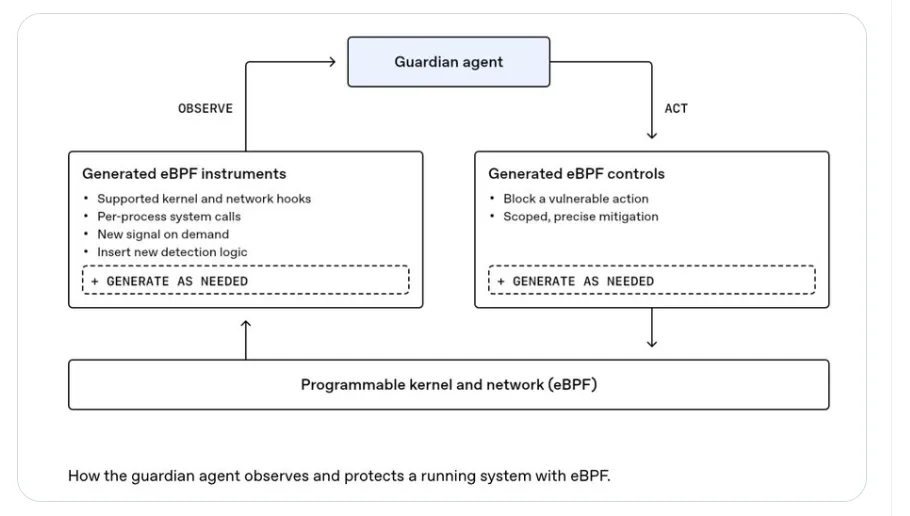
Diagram: OpenAI, from the Shirudo announcement.
- Observe (instruments): the agent drops in small eBPF programs that watch what is happening: system calls per process, network activity, new detection logic generated on demand.
- Act (controls): when it understands the bug, it writes a narrow eBPF program that blocks only the vulnerable action, not the whole service.
- Both kinds are “generated as needed”: there is deliberately no rule language to learn. The Shirudo team’s view is that agents work better writing code directly.
The four-step workflow
- 1. Discover. The agent scans code or reads a vendor’s security notice and traces which machines and paths are affected.
- 2. Build and test. On a separate operator machine, it reproduces the exploit, picks where to block it (inside the kernel, or inside the Java runtime), writes the shield and retries until the exploit fails and the service still works.
- 3. Sign and ship. The shield is signed and packaged as a .bee file, then published to an ordinary container registry (OCI, the same kind of registry used for Docker images). Each server pulls it and checks the signature.
- 4. Approve, watch, retire. An operator approves it. It can run in watch-only mode first. A “hit” counter shows every blocked attempt. When the real patch lands, the shield is removed.
All the features, in one list
- No-restart protection for running servers and applications.
- Two kinds of shield: eBPF programs inside the Linux kernel, and Java agents injected into running Java apps.
- Many checkpoints to hook into: security checks (file open, network connect, program start), kernel functions, functions inside ordinary programs, and network packets at several layers.
- Watch before you block: see what a shield would affect before enforcing it, with a hit counter afterwards.
- Signed shields only: after boot, the kernel accepts eBPF only from a signed loader. Even an attacker with full admin (root) access cannot load their own eBPF or switch a shield off without the signing key.
- Tamper-proof history: every load, unload and key change is measured into the TPM chip, so an auditor can later prove which shields were running.
- Self-protection: Shirudo seals its own files and process so root cannot quietly edit or hijack them.
- No always-on daemon: it is a one-shot command-line tool on both the operator and the server.
- Future-proof crypto: network traffic uses TLS 1.3 with a post-quantum key exchange, and signing supports a post-quantum algorithm (ML-DSA).
- Built for agents: the repository ships instructions files for coding agents next to the code.
- Open source and free: BSD 2-Clause licence, with the kernel programs dual-licensed BSD/GPL.
What sort of attacks can it stop?
This is the question the announcement answers least. So we read the example shields in the public code. Here is what is actually there, and how far each one goes.
| Attack type | Real example | What the shield does | Status in public code |
|---|---|---|---|
| Remote takeover via a bug in a runtime | Java4Shell (CVE-2026-114938) | Checks Base64 input in Java and rejects the one dangerous shape before the buggy code runs | Shipped; vendor demo on Elasticsearch |
| Web server takeover via PHP | PHP2Shell (CVE-2026-109618 and -109619) | Sandboxes Apache and PHP-FPM: blocks starting unapproved programs, connecting to unapproved addresses, raw sockets, and writing protected files | Shipped; contains the attack rather than fixing the bug |
| SQL injection | Classic ‘ OR 1=1 and quote-then-comment tricks | Java agent inspects every database statement and throws an error before it reaches the database | Shipped with a deliberately vulnerable demo app |
| Local user gaining kernel control | CVE-2026-31431 (kernel crypto socket bug) | Two options: refuse all AF_ALG crypto sockets (blunt), or refuse only the zero-copy trick the bug needs (precise) | Shipped |
| Kernel network bugs | e1000 driver, netem, IPv6 routing header CVEs | Counts suspicious packets but does not block | Detectors only, marked “unvalidated” |
| Attacker who already has root | Disabling security tools, loading malicious eBPF | Refuses unsigned eBPF, blocks detaching shields, logs every change in the TPM | Core design |
What these add up to:
- Best fit: bugs where the attack needs one specific, unusual action (a weird input shape, a rare system call, an odd flag) that normal traffic never uses. Block that action and the exploit dies while customers notice nothing.
- Containment: where a bug can’t be blocked precisely, sandboxing limits what an attacker can do after breaking in: no reverse shell, no dropped web shell, no surprise program.
- Out of scope (per Shirudo’s own threat model): physical attacks on hardware, a stolen signing key, a shield that is simply wrong, eBPF already inside the kernel before Shirudo starts, and a root user starting a Java program without the Java shield attached.
We tried it
Our CEO’s rule is that we try what we write about. Here is what happened on a standard cloud Linux box (kernel 6.18, no TPM).
- Cloned the code. The repository’s version file reads 0.0.0-dev. It really is pre-release.
- Compiled a real shield. We built Shirudo’s CVE-2026-31431 kernel shield with clang 18. It compiled into an eBPF object with a single lsm/socket_create hook (only warnings; the docs ask for clang 23).
- Could not load it. Our machine had no BPF security module enabled and no TPM. Shirudo’s docs are blunt: it “has no compatibility mode and no fallback for an older kernel.” You cannot run it on a stock Ubuntu or Red Hat server today. Use the project’s VM quickstart or online lab instead.
- Fun detail: our box’s Java was already the patched build 21.0.13.1. The real fix is still the patch; the shield only buys time.
Here is the actual kernel shield from the Shirudo repository. It is the whole program:
// SPDX-License-Identifier: GPL-2.0 OR BSD-2-Clause
#include "vmlinux.h"
#include <bpf/bpf_helpers.h>
#include <bpf/bpf_tracing.h>

#define AF_ALG  38
#define EPERM   1

char _license[] SEC("license") = "Dual BSD/GPL";

SEC("lsm/socket_create")
int BPF_PROG(cve_2026_31431_af_alg, int family, int type, int protocol,
             int kern)
{
    if (family == AF_ALG)
        return -EPERM;
    return 0;
}
Source: shirudo-dev/shirudo, upatches/kernel-cve. Compiled by us; not loaded (our kernel lacks the required features).
- SEC(“lsm/socket_create”) tells the kernel where to plug this in: the security checkpoint that runs every time any program asks for a new network-style socket.
- if (family == AF_ALG) return -EPERM; means: if the program wants a kernel-crypto socket (the door this bug is behind), say “permission denied”. Everything else passes.
- That is the trade-off in miniature: simple and safe, but it also blocks legitimate uses of that feature. The repository ships a second, more precise version that blocks only the zero-copy trick the exploit needs.
The Java4Shell shield is Java code, so we rebuilt its decision rule in Python to see what it lets through. This runs as-is:
import re

# The same input check Shirudo's Java4Shell shield adds in front of Java's Base64 decoder
def shield_allows(data: str) -> bool:
    n = len(data)
    tail = n % 64                       # bytes left over after full 64-byte blocks
    padding = len(data) - len(data.rstrip("="))
    risky = (
        n >= 65
        and 1 <= tail <= 3
        and 1 <= padding <= min(2, tail)
        and re.fullmatch(r"[A-Za-z0-9+/]*", data.rstrip("=")) is not None
    )
    return not risky                    # block only the one dangerous shape

requests = {
    "login token":             "dXNlcjpwYXNzd29yZA==",
    "64-char file chunk":      "A" * 64,
    "attack-shaped input":     "A" * 63 + "QQ=",
    "long upload, no padding": "A" * 1024,
}

for label, data in requests.items():
    verdict = "ALLOWED" if shield_allows(data) else "BLOCKED"
    print(f"{verdict}  {label} ({len(data)} chars)")
Output when we ran it (Python 3):
ALLOWED  login token (20 chars)
ALLOWED  64-char file chunk (64 chars)
BLOCKED  attack-shaped input (66 chars)
ALLOWED  long upload, no padding (1024 chars)
- The shield does not ban Base64. It looks for one very specific shape: 65 or more characters, a leftover tail of 1 to 3 characters after the last 64-character block, plus “=” padding.
- Normal logins, file chunks and big uploads sail through. Only the exploit-shaped input is stopped.
- That is the whole philosophy of Shirudo: cut the one wire the attack needs, leave the rest of the house powered.
What it costs
Shirudo itself is free. Running it is not. Prices below are in US dollars, list prices from vendor pages, checked on 24 November 2026.
| Option | Upfront cost | Ongoing cost | Hidden costs | Best for |
|---|---|---|---|---|
| Do nothing, wait for the patch | $0 | $0 | Days of exposure; emergency weekend patching; breach risk | Teams that can patch and restart within hours |
| Quick workaround (e.g. Java flag) | $0 | $0 | Needs a restart; may slow things; only exists for some bugs | One app, one bug |
| Shirudo | $0 software (BSD licence) | AI agent tokens, e.g. GPT-5.3-Codex at $1.75 in / $14 out per million tokens | Custom patched kernel, TPM 2.0, newest systemd and clang; engineers to build and maintain it; human review of every shield; may clash with other eBPF tools | Security teams willing to pilot pre-release tech in a lab |
| KernelCare (rebootless kernel patches) | $0 | $5 per system per month | Kernel only (libraries cost extra); you wait for the vendor’s fix | Fleets on mainstream Linux wanting fewer reboots |
| CrowdStrike Falcon (endpoint protection) | $0 | $59.99 to $184.99 per device per year (cloud bundles by quote) | Add-ons and minimums; detects and responds but does not write custom shields | Broad detection across many machines |
Where the money really goes with Shirudo
- The TPM is usually free. Most modern servers have one, and on AWS the virtual NitroTPM has no extra charge.
- The kernel is the big cost. You need a development (bpf-next) Linux kernel plus Shirudo’s own kernel patches, which no mainstream distribution ships. Building, testing and maintaining a custom kernel is real engineering time, every month.
- Agent costs are small per shield. Our estimate, not a vendor figure: an agent session that reads 2 million tokens and writes 200,000 would cost about $6.30 on GPT-5.3-Codex. A busy month of 50 shields is roughly $300. Your numbers will vary with model and effort.
- Reviewer time is the cost nobody prints. Every shield needs a human yes. During a big incident with many bugs at once, that queue becomes your bottleneck.
Which option suits whom
- Solo developer or small team: patch fast, use free workarounds, and read about Shirudo. It is not for you yet.
- Mid-size team with a security engineer: try the online lab or VM quickstart to learn the model. Keep KernelCare or your usual patch tooling for production.
- Large security org with kernel skills: this is the audience. Pilot it on an isolated test fleet and contribute shields back.
Pros and cons
Pros
- Buys real time. Protection in front of a bug while patches are tested, without restarting the service.
- Surgical. Shields can block one exact action instead of taking a whole feature or server offline.
- Hard to switch off. Even a hacker with root can’t load their own eBPF or detach shields without the signing key.
- Auditable. Hardware-backed records prove what protection ran and when, which helps with compliance.
- Covers kernel and app. Works inside the Linux kernel and inside running Java programs.
- Serious pedigree, free code. Built by the Isovalent team at Cisco (the people behind the Cilium and Tetragon eBPF projects), open source under a permissive licence.
Cons
- Not production-ready. Pre-release, version 0.0.0-dev, with no stable release yet.
- Steep setup. Needs a development Linux kernel with extra patches, a TPM 2.0, systemd 256 and clang 23. It will not run on a stock enterprise server; we confirmed this ourselves.
- Can clash with tools you already run. Because only signed eBPF may load, other eBPF-based tools such as Cilium and Falco can be affected, according to early hands-on testers.
- A wrong shield is still trusted. Signing proves who made a shield, not that it is correct. A buggy shield can break real traffic, and several shipped detectors are marked “unvalidated”.
- Human review may not scale. The Register pointed out that the plan has humans checking every shield, and nobody has said how that works when dozens of urgent bugs land in the same week.
- Thin evidence so far. One vendor-run demo on one Java app. No independent results. The Register also noted both companies have a commercial interest: more Codex usage for OpenAI, more eBPF adoption for Cisco.
- Some shields are blunt. The simple kernel crypto shield blocks a whole feature, not just the attack.
Key takeaways
- Shirudo is a free, open-source Linux tool from OpenAI and Cisco that lets AI agents write temporary “shields” which block an exploit on a running server, with no restart, until the real patch is installed.
- Public examples cover Java4Shell, SQL injection, PHP2Shell containment and a kernel crypto bug, plus locking out attackers who already have root from tampering with protections.
- Shields are signed, approved by a human, logged in a TPM chip, and removed once the patch lands. Shirudo proves who made a shield, not that it is correct.
- It is pre-release and needs a custom patched kernel and a TPM 2.0. We could compile a real shield but could not run it on a standard Linux server.
- The software is free; the real cost is kernel engineering and reviewer time. For now it is a lab project for large security teams, and a strong signal of where server defence is heading.
- For the governance side of agent deployments, read our guide to AI Product Guardrails.
Frequently asked questions about Shirudo
What is Shirudo?
Shirudo is a free, open-source Linux tool from OpenAI and Cisco. AI agents use it to write temporary shields that block an exploit on a running server, with no restart, until the real patch is installed.
Does Shirudo replace patching?
No. A shield is a stopgap, and the plan is always to remove it once the proper fix is installed.
Who approves a shield before it runs?
A human approves each shield before it is loaded into a server.
Can I use Shirudo in production today?
Not yet. Shirudo is pre-release, and it only runs on a specially patched Linux kernel with TPM 2.0.
Does Shirudo work on Windows or Mac servers?
No. Shirudo only works on Linux.